Appearing on The B2B Club Podcast
Discussing what B2B E-commerce buyers really want?
Published: Mar 26, 2024
Last Updated: Feb 17, 2026
In this episode:
🎯 Technology should serve business needs, not dictate them
“technology works for me. ; I don’t work for it.”
Chris Gee, CTO B2B eCommerce Association
I was delighted to be asked as an expert speaker to contribute to the definitive guide to B2B eCommerce buyer demands with Hakodo, a buy now, pay later service for B2B eCommerce businesses such as manufacturers, wholesalers, and distributors.
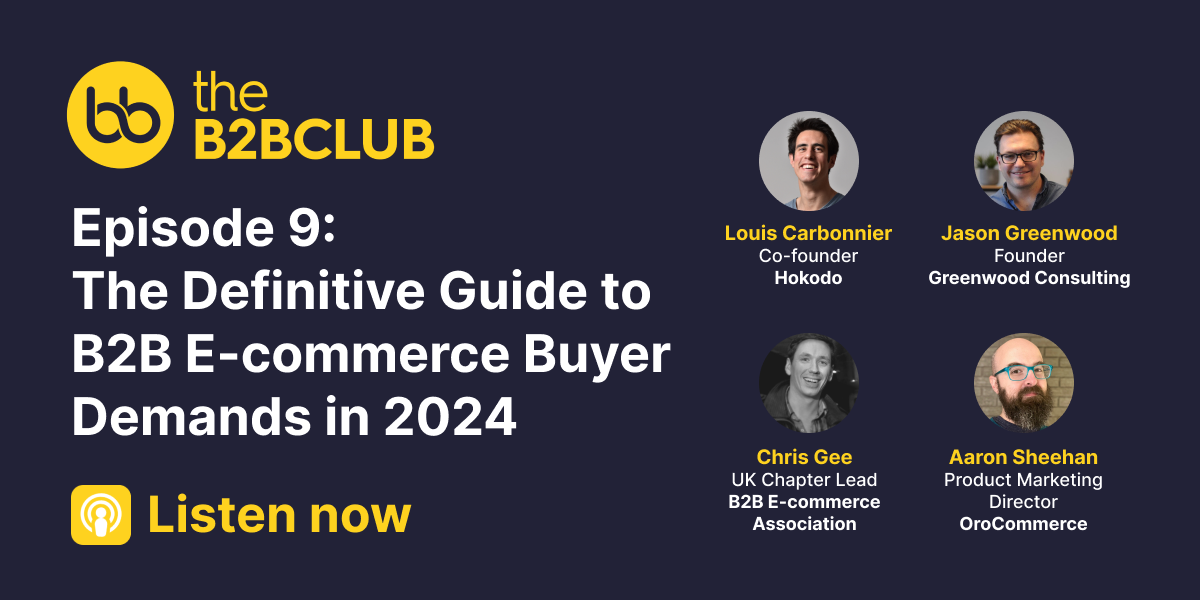
In esteemed company, my co-stars and host for this episode were:
Louis Carbonnier – Louis is the co-founder and President of Hokodo, he leads the product strategy of the company’s payment terms solutions.
Christopher Gee – I am the CTO and Global Director of The B2B eCommerce Association, the leading professional network and resource for companies and merchants seeking to succeed in B2B eCommerce and digital transformation.
Aaron Sheehan – Aaron is the Director of Product Marketing at OroCommerce, the leading eCommerce platform for B2B that helps distributors, manufacturers, wholesalers, and large retailers perform online transactions between businesses.
Jason Greenwood – Jason has more than 23 years of experience working in eCommerce, and helps mid/large wholesale brands sort out their people, process, tech, ops and data challenges so they can execute on the huge opportunity that is eCommerce.
The B2B Club Episode 09: The Definitive Guide to B2B E-commerce Buyer Demands
Do you know what B2B E-commerce buyers really want?
In this episode, Hokodo’s co-founder and President Louis Carbonnier is joined by B2B E-commerce experts Jason Greenwood, Chris Gee and Aaron Sheehan to take a deep-dive into the key findings of our recent report, The Definitive Guide to B2B E-commerce Buyer Demands in 2024.
Transcript of The B2B Club Episode 09: The Definitive Guide to B2B E-commerce Buyer Demands
00:00:04 Louis Carbonnier
Okay, Very happy to welcome you to the results of the definitive guide to B2B e-commerce buyer demands in 202 4 that we conducted with the panelists today. And, this is fundamental research going back to the customer needs in e-commerce in a B2B context. I think this was really Overdue research because there’s a lot going on about what are the merchant needs, what are the tools, the solutions for the merchants. But there’s not that much going on for the buyers. And when we survey them, we see that there’s quite a bit of discrepancy between what the buyers expect, what B2B buyers expect and what merchants have to offer today. I’m Louis co-founder and president at Hokodo.
00:01:00 Louis Carbonnier
I am very, very pleased to welcome three wonderful co panelists today. Let’s dive right in. Very pleased to welcome Chris, Jason, and Aaron this afternoon. B two B, we’ll see that’s one of the findings is massively different from B two C. And when we want when we started to survey hundreds of uh b two b buyers for this. Uh, this study. We thought we also had to surround ourselves with people who brought massive B two B expertise, people who live and breathe B two B, who understand the difference between B two B and C, who’ve seen merchants going through their second or third migration trying to tackle, B two B clients and not always being very successful doing so, And you know, this has contributed quite a lot of insights and hence the panel today.
00:01:56 Louis Carbonnier
To bring all this brain power together, so guys, maybe if I could ask you to say a few words, introduce yourselves. Maybe starting with Chris from the left hand side.
00:02:08 Chris Gee
Sure. Hey, how you doing? Hey Chris. Yeah thanks for having me. Thanks for letting me be involved and contributing to this as well. So I am the UK lead for the B two B E commerce association. My colleagues there and I are. Ambassadors for B two B merchants and tech vendors, And it’s our role to create a community of professionals who really want to succeed. So we’ve spent the last few years building a network of merchants, of tech partners like yourselves, and advisory boards around the globe to offer events and.
00:02:51 Chris Gee
Learn ing and contribution to papers like this to make sure that people are actually getting dedicated B two B advice and not second hand retail facts that we have to translate to fit our needs.
00:03:07 Louis Carbonnier
Fantastic, good to have you, Chris. Still continuing left to right, Jason. Maybe if you want to say a few words of intro.
00:03:16 Jason Greenwood
Absolutely, once again thank you very very much Louis for hosting this, You know, Not only creating this original research and going to the effort to really dive into this, but also having you know me as a guest panelist. And look, I know and respect Chris and Aaron tremendously, so it’s amazing to be in such esteemed company. I’ve been working in e commerce for over twenty years. For the last three and a half years, have owned and run Greenwood Consulting, which is a specialist B two B e commerce consultancy. I also run and have founded.
00:03:51 Jason Greenwood
The E- commerce Edge podcast, and we have almost three hundred and fifty episodes published of the podcast. So it is my absolute pleasure to to be here today.
00:03:59 Louis Carbonnier
Yeah, thanks a lot, Jason. And t here is so much stuff that goes in depth into e commerce on your podcast.;. It’s amazing. And to everyone, I recommend it as a huge resource. So thank you so much for joining, Jason. And last but not least, this is alphabetical Aaron maybe welcome Welcome to the panel.
00:04:20 Aaron Sheehan
Thank you. I was going to say thank you for for having me on, and it’s funny because normally when someone named Aaron is in an alphabetical sort, they’re usually at the first. So, it was, it was refreshing to.
00:04:33 Louis Carbonnier
We went for their last names,
00:04:35 Aaron Sheehan
Exactly exactly for the surname. So thank you a lot of respect for Christopher and Jason, the content that their organizations put out. My name is Aaron. I am the director of product marketing at Oro Commerce, which is the only single license, E-commerce platform built ground up for the scale of modern manufacturer, distributor, or wholesaler. We’re, a B two B focused commerce platform built by the original co-founders of Magento, which you probably heard of. I am the director of product marketing. I’ve been in the e-commerce space for about a decade, and most of that time has been spent actually serving B two B brands, manufacturers and distributors. Sometimes people doing making their first.
00:05:18 Aaron Sheehan
Early moves into e- commerce, uh the first their first step into digitization and the internets. Uh and sometimes people on their third or their fourth uh rodeo, uh trying to make it better. So really happy to be here and very interested in the research because you’re absolutely right. There’s so much about sellers and so little about buyers. So this is really great to see.
00:05:41 Louis Carbonnier
Yeah, And well, as you can see, these three guys know a thing of or two about B 2 B. So it’s going to be a pleasure for me to, you know, pick their brains and get the insights. And just to round up the intro, so as I said, I am one of the co founders at Hokodo. We’re the leading payments provider for B two B in Europe. More than one hundred thousand companies use Hokodo to access better payment terms. And essentially what we do is we help merchants.
00:06:14 Louis Carbonnier
Sell more by providing a better payments experience to their buyers. So, that’s how we contributed to the to the survey by providing this angle on the on the checkout. So, let’s let’s dive into it and look at some of the most striking insights that Chris, Jason, Aaron and I gathered during this survey. As I mentioned, we surveyed hundreds of um of buyers. Fundamentally, We wanted to, you know, client is king, and we wanted with this research to see what B2B buyers were really after when they purchase online and what exactly makes them specific. And, there’s you know a lot of research about e-commerce in general, but not that much when it comes to B2B e-commerce and even less when it comes uh to the needs of B2B buyers.
00:07:11 Louis Carbonnier
So that’s really what we were after here. Without further ado, let’s jump into the insights. So number one, And this one I nearly fell off my seat when I when I saw it, because everyone talks about B two B trade moving online, and in fact it’s already online. You know among the hundreds of buyers that we surveyed ninety three percent of them. Choose online channels when doing uh when procuring for goods or services whatever it is. So honestly, I was I was expecting some something around fifty sixty percent, but it came up much higher than that I think we’ll we’ll discuss it with the panel. But my my two cents there is that even when someone is purchasing a high value item or something old fashioned at the beginning.
00:08:08 Louis Carbonnier
Of the purchasing journey, there is always some kind of online consideration. I want to see the catalogue. I start my purchasing journey online. Of course, not all the transactions are done end-to-end online. I think that you know, depending on the country and how advanced the economy is, that’s around ten to twenty percent. But nonetheless pretty much an overwhelming ninety-three percent, Have at some point an online touchpoint. So I think e-commerce is not really an option. And, when I look at our clients at Hokuto, and we discuss a bit their channel mix, the one channel that’s growing double-digit is the online channel, it’s e-commerce. And I think any growth strategy today is an e-commerce strategy, and we’ll be discussing some of this later on.
00:09:06 Louis Carbonnier
Now, ninety three percent of B two B buyers go online, but unfortunately, The experience that they get is not not that great because ninety eight percent of them report facing challenges during their purchase journey. This is I mean this shows the gap between expectations and reality. It also says a lot about, you know, the opportunity for those who will be able to bridge the gap and deliver. A decent experience. We’re not talking about rocket science here, but really delivering the basics of user experience. Slow, lengthy process. I guess the UX has become pretty standard in B, two C B, two B There are variations by industry. ;. You have different people that need to approve of a transaction and so on, so potentially it’s a bit more difficult.
00:10:06 Louis Carbonnier
But, it’s still amazing that fifty five percent of the challenges are linked to to UX, Then real time product availability thirty nine percent repeat order same thing that sounds like a pretty basic feature in B two B buyers come back. You know, we see buyers who make ten twenty transactions every every month they need to restock. So this. You know, This feature I’m sure Aaron will say that this is like part of the package of any B2B platform that’s just adapted to the needs of B2B. But still in nearly one third of the cases, this is not part of the standard functionality. Then three that talk about payment. I mean, this speaks to my heart because.
00:11:03 Louis Carbonnier
Payment is so key to creating trust in the platform. To this is when where the rubber meets the road, when the conversion actually happens on the platform. And, we see that there’s quite a lot of leakage still today, twenty twenty three, Twenty seven percent of the cases, no payment terms offered or it’s the first purchase. You can’t be, you can’t pay on credit terms. And the last one, unsuitable payment methods. So I think when we look at payments, there’s the UX itself, how many clicks you have to go through. There’s what are the terms that are offered to you, but also what is the settlement method? Do you get to settle by card? If you make a B2B purchase and it’s more than $5000 or euros, credit cards probably not the right method.
00:11:59 Louis Carbonnier
In that case, do you support bank transfer? Do you support direct debit? Do you support local methods? I think this is something where we hear quite a lot of discontent. Then, the next one I wanted to cover is eighty three percent of B two B buyers report abandoning a B two B purchase for these reasons that we’ve seen, you know, lack of the right payment methods, the poor UX. So, this thing that we’re talking about, this is not theory. It translates into the bottom line, into the dollars that you get at the end of the day. This is missed opportunities. Why spend so much in marketing in acquisition, if at the end, you have a prospect who abandons their purchase? There’s so much money left on the table, and I think this is one of them. I mean, good news is when this is one of the big levers.
00:12:54 Louis Carbonnier
Of improvement that we have as an industry, so buyers expect swift credit decisions. More than eighty percent of them expect credit decisions that happen within a day. I think they come from a world as individuals being able to do one click checkout on Amazon, or you know any other B two C platform for that matter, and then suddenly you reach a B two B registration flow. Where you need to pre-register, be vetted, eventually be granted payment terms or you’re allowed to open a trade account. Things that you would do much faster, either on B2C e-commerce or in real life in good old B2B. So this is really a sticking point and being able to provide real-time decisions.
00:13:48 Louis Carbonnier
I mean, At Hokuto, we try to do it in less than a second. That’s our benchmark. So here there’s an expectation that’s more modest of less than a day, But apparently, it’s not that expectation is not met in more than four buyers out of five. The next one is when we ask B two B buyers in the current environment, what could make them increase the size of their basket. What could. Drive their loyalty, seventy nine percent unexpectedly see payment terms as something that’s important for their growth. I think we need to put ourselves in the shoes of the B, two B buyers and how they’ve built their working capital cycle in traditional B two B trade. More than one transaction out of two benefits from payment terms, And then if you ask me as a B two B buyer to shift my purchase online.
00:14:47 Louis Carbonnier
And then I go online and I don’t get those payment terms. This is going to give me to hit me in my working capital and how much liquidity I can then deploy to the rest of my business, and it’s constraining my growth. So, in an environment of increasing interest rates and so on, Where liquidity really becomes the ” cash is king ” that becomes the constraining factor for many businesses. And seventy nine percent Say that those payment terms are critical in how they compare suppliers. If all else being equal, If I am buying the same product and I have the choice between supplier A and supplier B, And supplier A gives me thirty day payment terms, and supplier B tells me pay upfront, I am going to go to supplier A. That’s a no brainer. So yeah, no wonder then that eighty six percent of B two B buyers.
00:15:44 Louis Carbonnier
Report that payment terms are a key consideration when choosing their suppliers. So, I think that’s some of the findings we gathered in the report. I invite you to download the full report to access the results of this survey. And, you know, a lot of actionable advice that’s very tailored to B two B. And as we do this, of course now let’s Let’s move to the interesting bit. Use these, keep these insights in the back of our heads and move to the panel. So again, Chris, Jason, Aaron, good to have you today. Let me start with a question for Chris. But of course, we can make it quite dynamic and interactive. If Jason and Aaron you want to.
00:16:41 Louis Carbonnier
Shed light or bring contribute a different perspective. Feel free to expand and we make this, a dialogue. So Chris, Obviously, you speak to hundreds of merchants as part of the B two B commerce association. You meet your you lead the UK chapter. So, you know, the UK is one of the most digital economies in the world, you see so many so many of them. I guess you know this inside out, but when you looked at the results from the from the survey, what number, what statistics, what finding really struck you the most?
00:17:18 Chris Gee
Yeah, great question. Well, I wasn’t surprised by ninety eight percent of people facing challenges. I felt like that was something that probably would have kind of reinforced my views because for a decade. B two B businesses have kind of been hamstrung into using B two C built tools to put their businesses on, and so we’re shoehorning users into a flow that isn’t designed for them. And so, no wonder they would find that frustrating. You know, if you are buying for work, you are probably not buying for yourself. So having pop ups to sign up for a newsletter and.
00:18:05 Chris Gee
Get these reward points. They’re not always things that that person’s interested in. They want to log in, see that price, get it done and get out. But. One of the things that I did find interesting was when I started to dig deeper into the report. So, the headlines are fantastic for a quick read, but if you start to read into some of the tables, there is some really interesting numbers in there. And for me, it was that for online and offline orders Over forty percent of people were looking for better customer support, And that struck me as a number because this has obviously come from our merchants buyers. They’re telling, you know, my contacts, my customers of my B two B agency as well. We want you to do better customer support. But B two B for forever has been steady. It’s relationship based. It’s human to human, so why are they demanding?
00:19:04 Chris Gee
Better customer support, like where is that coming from? And I think what’s happening is we’re now able to scale our businesses beyond the normal amount of customers that we could traditionally service. And we’re focusing on scaling sales, scaling conversion, scaling for growth. But are we taking the time to stop and also look at post-sales? Being able to grab hold of your invoices, being able to resolve a problem with pricing. How, are we speaking to this new wave of digital natives who are now running and owning businesses who prefer to live chat, WhatsApp, social message? And and to me, Some of the detail in this report kind of added some good insight to some of the things that I kind of knew, but didn’t have any solid data too. So I that that’s the bit that struck me and I am.
00:20:00 Chris Gee
Kind of happy that that number was there. It was a bit higher than I thought it might have been.
00:20:08 Louis Carbonnier
Yeah, we’d want that number to be to be higher, but still, I think you know making a good point where B two B is not a sausage machine like B two C can be. It’s high touch with a lot of product variations, A lot of things that need to be adjusted per s, ale. And so and. Without a good customer service, it’s probably you can’t deliver the full experience that those professional buyers have. And, the stakes are much higher than when you’re buying an extra pair of shoes for yourself. You’re actually making a big purchase for your business.
00:20:48 Chris Gee
And you know, even if you’re thriving in B two B, let’s say you are absolutely crushing it, you are getting everything right and you are growing and growing and growing. Are you focusing on the customer service part as well, or have you just got your eyes on growth? Because, you know, I used to work in B, two B sales as a sales rep, and it was all about the relationship. Really tight conversations, being able to get hold of somebody when you needed them. And when you’ve agreed a price, When you’ve given your loyalty to a business and you’ve negotiated something, and then it’s not right.
00:21:26 Chris Gee
It feels a bit more personal than if you are going online. And your tin of beans at Tesco has gone up by two p. You know, it’s that you like that’s not my price. You want to be able to get somebody there and then, otherwise you are going to have to raise an invoice, then you are going to have to request a credit note, then you are going to have to process a credit note. And yeah, It’s just is, is it’s effort in your business that you don’t want to take on more work.
00:21:51 Louis Carbonnier
Absolutely. Thanks a lot Chris for for these insights. Jason, maybe turning to you, There’s this massive statistic that ninety three percent of B two B buyers are now using e commerce channels. Which I mean, for me was literally mind blowing. Do, you still see in your consulting activities as a you know, as a B two B expert? Do you still meet businesses who haven’t migrated online or whose.
00:22:24 Louis Carbonnier
Whose migration is still happening? What would be your advice to those businesses?
00:22:30 Jason Greenwood
Yeah, look, it’s very common. Unfortunately, It is still massively common for B two B brands to not have any form of e commerce or what they consider digital commerce is usually EDI maybe punch out something like that. And they kind of implement that. And they call it good, and they don’t offer a self service e commerce function. For their small and medium sized customers, and so they’re really only servicing through digital channels. Their very largest whale customers that can integrate by EDI, And they’re missing out on bringing digital self service to the rest of their customer base. And that statistic that you called out there ties in nicely to one of the other big statistical callouts that I noticed in the report, Which was once again, it wasn’t one of the main headlines, but it really spoke to me, which is that.
00:23:18 Jason Greenwood
Sixty nine percent of B two B buyers find researching suppliers online on their own more effective than interacting with a sales representative during the discovery process. And what that speaks to me is not only do many B two B brands, not do e commerce at all, but of the ones that do, We find that in excess of probably ninety percent of those have a gated experience. Meaning that unless you authenticate, you can’t see the catalog. You can’t even see the products that they carry. You can’t see prices, you can’t see MOQs, You can’t see anything in relation to what this brand actually does, except for maybe the headline on the website and maybe their brand name. Now this is a massive problem. This is a massive challenge because increasingly B two B buyers are identifying and finding their suppliers online. They’re searching online for their suppliers in the same way that in their personal life, they’re searching for that thing that they want to use in their home.
00:24:17 Jason Greenwood
And if the experience is not ungated, what that means is Google can’t even index your catalog. And with amazing platforms like Oro and others today, We now can ungate the experience whilst not showing some of those maybe mission critical private factors that B two B businesses don’t want to expose. We don’t have to expose inventory levels. We don’t have to expose pricing. We we don’t have to expose MOQs. You don’t have to expose all these other things so we can We can take a hybrid approach. We can say, okay, we’re going to expose our catalog, But we’re going to show the most restricted or limited version of our catalog that is available to absolutely everybody who signs up as a customer with us. Or, we’re going to show the catalog and the most expensive pricing tier we have available and then create an opportunity for people to inquire for better trade pricing. So we have this hybrid model that businesses can go to the market with, but I think.
00:25:13 Jason Greenwood
One of the very first things, Especially for that percentage of B two B brands who don’t do e commerce at all, they just simply do not offer it gated or otherwise, One of the things I recommend is starting with an adoption plan before you even get into the scoping phase of the project. And I am not just talking about a customer adoption plan. ; I am talking about an internal adoption plan too, because at the end of the day. With your salespeople and field sales reps, internal account executives, customer service, et cetera, the reality is unless they are on board with this new digital channel, They are never going to be able to onboard train and upskill their customers on using these digital channels. So it’s a synergistic relationship between your internal team and your customers. And unless both are on board for that journey, you will never get high enough adoption.
00:26:05 Jason Greenwood
To see ROI on what is admittedly a very big investment for businesses to make in self service e commerce,
00:26:12 Louis Carbonnier
Yeah, And there are so many of those e commerce projects that end up not delivering. I think in general, but then in B two B in particular. As a consultant in this area, does it frequently happen that you are called into rescue a merchant who’s, Halfway through a transition, And maybe they they only saw the kind of technical part of the tool that needs to be rolled out, and not the internal adoption plan, you know, The cultural change that needs to happen for also the company itself to be able to use that opportunity. And deliver to the end customer.
00:26:53 Jason Greenwood
Yeah, I think oftentimes B two B brands. They go into it with selfish intent and the customer knows it. Right, it’s all about oh how can we make the business more efficient? How can we take CPQ online? How, can we reduce the manual effort or the at least the administrative effort that our customer, um you know that our that our sales team are spending on administrative activities as opposed to the value add of of building relationships and going out and hunting new business. I I think that is very You know, B two B brands they’re very operationally and technically focused, and as a result of that, it’s a very inward look. It’s a very myopic view on what e commerce should be doing for the business, not what e commerce should be doing for the customer. And I think when we turn it outward and the focus is really outward on the customer, then we work back from that. What is the experience we’re trying to create? You know, B two C and D two C has done this for years. They’ve been, you know, they’re very advanced in terms of the customer experience on the front end. And.
00:27:49 Jason Greenwood
Marketing teams are making sure that the experience is pixel perfect. The brand is presented in the best light. We’ve got search, merch, personalization technology. We’ve got all these amazing user experiences in the B, two C and D, two C world. And in a B two B world, we’re worried about tech and ops. We’re worried about efficiency. We’re worried about all that stuff, but so are our B two B customers. They’re worried about efficiency. They’re worried about getting in and getting out They’re worried about making sure they see the right catalog with the right price with the right buying increments, et cetera, et cetera. And then I think also, even from a digital customer service perspective, I remember, you know, Chris called out something really important here, which is that even of the brands that I work with that either have an existing e-commerce website or they’re doing it for the first time, they don’t usually offer the digital.
00:28:40 Jason Greenwood
Customer service channels that the B two C and D two C world have offered for a decade. How many B two B brands offer live chat on their B two B e commerce website? I would venture to say almost zero. I almost never see it. So these types of experiences, this digital concierge service with the video uh customer service, right, Which is becoming increasingly common in the B, two C and D two C world. This is not common. You never see it. You almost never see it in the b2b world And so, I think t here is a tremendous opportunity for B two B brands to take advantage of this existing gap, and they really can leapfrog their competitors. And it’s the bar is set pretty low, I’ll tell you that right now in the B two B world. So, It is not that difficult to stand out as a supplier that has a superior digital customer experience. It’s just not that hard to be better than everybody else or.
00:29:36 Jason Greenwood
Or, in most cases, you are offering a digital experience that simply does not exist with your competitors.
00:29:41 Louis Carbonnier
Yeah, And that point that you are making about a lot of B, two B merchants having a product centric approach, inward focused instead of thinking about in basic terms about the customer I think that’s a good segue to a question. I wanted to ask to Aaron. Maybe this explains why a shocking ninety eight percent of buyers, Are saying that they are they are facing issues at the checkout. Is this something that resonates with you and Oh yes, how do you how do you explain that?
00:30:14 Aaron Sheehan
Well, I mean, I think I think Jason just alluded to it a little bit, But I would say, e commerce, e commerce for a lot of B, two B companies is an IT cost center and not a revenue center. It’s seen as the equivalent of paying for printer ink. So that operational focus tends to mean that the ERP is the center of all IT procurement focus and attention, If whether that’s an off- the- shelf system or some kind of custom Frankenstein’s monster that’s been built over thirty years out of custom tables and little micro apps and things like that. But because of that, I think the transacting piece of e-commerce, the user experience, and the customers, the self-service customer.
00:30:59 Aaron Sheehan
Service piece of that as well, so the being able to pay an invoice, being able to look up order status, being able to see past orders, Being able to uh view who’s an approved buyer maybe? And you know what level of permissions they have that kind of stuff that historically requires a telephone call or an email. You know all of that gets sort of wrapped up into a user experience that is often forgotten in favor of making sure that you know there is pricing. For some people on the web, and that’s it; that’s all that exists. So, and I would say B two B buying is complicated, right? So when you get to the checkout, T here is usually a lot more information that goes into that purchase than there is Louis. When are if I am spinning the wheel on my Shopify site to get that deal on my socks? And then I just click the button. And now I have socks. It doesn’t work that way for B two b T here is a lot of fulfillment information. T here is a lot of financial information. I may have multiple layers of approval and.
00:31:55 Aaron Sheehan
Every time I come back to the site, I have to interact in some way as part of a long term buying process. And so the checkout, because it’s under invested in, can’t replicate, can’t handle the complex buying cycle in B two B. So a lot of you know, it’s unfortunately, it’s true that ERP runs everything and the e commerce checkout gets somewhat forgotten.
00:32:18 Louis Carbonnier
And what’s the most common mistake that you’ve seen among your clients?
00:32:24 Aaron Sheehan
Um, I think t here is two things that that stand out to me. One is speed, and I mean that the the checkout, the whole experience is simply not optimized to move quickly. T here is a lot of calling back to the ERP with playing ” M other May I ” with some back office system that was built in the eighties and maybe not doesn’t respond in a timely manner to real time questions and user interactions. And I mean, I don’t know, Jason and Christopher. Have you ever seen a have you ever been on a B two B site where the checkout took a minute plus to complete? Because I have. Right,
00:33:02 Jason Greenwood
We see that as a massive problem in the B two B space. Most and I attribute that usually to the fact that our carts are have many, many, many more line items and units in them than the average C cart. I think the, I think the global average in the BDC world is like two point two or something like that, depending on the data and depending on the market items per cart. That’s that’s kind of the global average. In, the I don’t know what the statistics are in the B two B world, but it must be more like twenty or thirty lines. So, the reality is, in order for a B two B checkout to be fast and efficient, It not only has to process what’s in the cart, but it also has to process based on the price list.
00:33:44 Jason Greenwood
Based on the other rules of that particular checkout, And sometimes we even have a different price list per location for that B two B buyer because you know that location that we’re delivering to might be further away than another location in our in our chain. For example, so there is so much more complexity, and that’s just one element of complexity in a B two B checkout. So, what we see is that the checkout in the B two B world typically. Has orders of magnitude more friction associated with it than in the B, two C and D two C world, Where they’ve they’ve streamlined the bejesus out of checkout in the B two C world. But in the B two B world, checkout can often be clunky. It can be slow. And to your point, Aaron not only not only can the cart itself and the cart logic be very slow, But then when we think of exposing, for example, where someone stands in relation to their credit limit.
00:34:41 Jason Greenwood
Where they stand in relation to credit stop, where they stand in relation to order approval workflows, things like that. It starts to bring in scenarios that we would just never see in the B two C world. And if all of those use cases and, in some cases, Edge cases have not been catered for in the checkout. We’ll just get abandonment, and they’ll just the customer will just revert to it’ll become a self fulfilling prophecy. They will abandon, and they’ll pick up the phone to call their sales rep. And then they’ll wonder,” The merchant will wonder,’Well, why are we not getting twenty five to fifty thousand dollars in e commerce?’And all of a sudden, it’s because everybody’s abandoning at the cart at the checkout, because the experience is so rubbish.” Well,
00:35:21 Aaron Sheehan
And Jason I mean, one of the other things they might do is they might not pick up the phone to call their rep. They might just go on some on the competitor’s website or go to Amazon Business. There is one other part of this too which is I think, Lack of information, so and what I mean is, um, because of everything Jason just mentioned and and the complexities of the checkout, The buyer has to enter a lot more detail at the point of the transaction. So, the ship to’s, The carrier account numbers, if they’re using a carrier account, for instance, maybe more than one. Um PO number open POS that are still in use. I have to type all. I have to go look that up and type it all over again. Tax exempt certification numbers comes up for some buyers.
00:36:01 Aaron Sheehan
So here is the thing, if it’s a guest checkout on a B two C site, I don’t expect that brand to know those things about me. But if I have a business with you, if I’ve been transacting with you, if I have an account with you, if I have open credit with you, kind of expect you to know those things in advance. And I don’t the speed is not just the technology, The technological speed of processing a giant cart, but there is also the perceived speed of. Am I having to like type in a huge amount of extra detail, every single time I make a transaction that slows you down too? And so, you know, the e- commerce platform you should you should know things about your buyers, right? So ask the right questions in advance and make sure that your checkout whatever it is, can remember things that it’s that it’s being told better than maybe chat G P T can.
00:36:47 Jason Greenwood
And thank you. Sorry Louie, I was just going to add Eric, you raise a very good point that. In addition, we have this wonderful thing in the B two B world called “will call,” right? Which is effectively the equivalent of “, click and collect ” in the B two C world, right? And so, in many cases in the B two B world, we need to do inventory transfers between warehouse locations to facilitate will call. And. So that adds an additional layer of complexity within the B two B world that isn’t always present in the b tC world. But yet, will call can compose a significant if.
00:37:22 Jason Greenwood
If I am on a job site and I need some goods to finish complete a job, I want to and a warehouse is nearby. I want me to be able to nip down the road. I want to be able to get all all the gear, and then I want to be able to go back, And i want tO be able To complete this job, right, especially if it’s in the construction sector or similar. And so we have all the additional complexity of warehouse locations inventory locations. We have most B, two B brands are a hybrid maybe of a manufacturer, distributor and wholesaler. Rarely are they just one. And so, therefore, In some cases, they will hold inventory of some of their catalog, but not the rest. So, Showing what is available from a given location available for will call right now versus at dates in the future. We just have so many orders of magnitude higher complexity in the B two B world that the checkout is just. It’s kind of fraught with challenges when you don’t think it through and all the use cases for it.
00:38:12 Louis Carbonnier
Yeah yeah yeah absolutely and yet despite that complexity. Vital to deliver that kind of, you know, faster, smoother experience at checkout. One thing we measured is like you know, every second of lag or latency that you have in your in your checkout is a seven percentage point decrease in conversion. So, that’s leakage, and that’s people who are, you know, too tired, pick up the call or worse, as Aaron was saying, they go to your competitors website and you never see them again. One question I.
00:38:46 Louis Carbonnier
You know, I wanted to ask from from you as B two B experts is we see that there’s a majority of buyers who say that they will abandon a basket. If payment terms are aren’t offered. I’d be interested to get your take on this also with your different you know, geographical angles. Chris, you have a kind of North America and Kiwi cap on and yeah. Know ing, how how are the how is the payment experience evolving in your respective geographies, what are the expectations these days? How do you see it evolving? So that’s a question to all of you. Whoever wants to take it.
00:39:26 Chris Gee
Well, I was going to say, I think it is broad and it does change. For me i I come back to the human to human relationship part, and it’s not necessarily payment terms aren’t offered sometimes it’s, My payment terms aren’t here. I want to deal with you on my terms at my time of day, and my terms that I’ve agreed with you aren’t here, And you are forcing me to do it in a way I don’t want to do. Yeah, I can somewhere else i can do it And so, you know, They’re seeing you maybe as their supplier slipping behind not being as good as another supplier.
00:40:08 Chris Gee
Wondering why you can’t offer that when so and so can, and typically it’s a technology thing; it’s never really more than that. But I think it’s more. I think people find it more frustrating because it’s more personal. They they want to use you; they’ve agreed terms to do it. Why aren’t they everywhere? I touch your business, and especially if they’re a really big buyer, you know. For the for the biggest of the biggest, Jason says this in his podcast all the time. But the biggest of the biggest, R E D I, they have that. They demand they get it their prices their way digitally whenever they want it. But your next layer down, the big clients, The ones who make up a big chunk of your business, maybe they’re not getting that and that’s frustrating them. And that’s probably why they.
00:41:07 Chris Gee
Be coming that squeaky wheel about it because they want it and they want it ages ago.
00:41:13 Aaron Sheehan
I would add, I mean, we have to remember that in B two B, it’s teams of people buying from teams of people, And so the person who is doing the buying is not paying the invoices in that organization. And so if I as the buyer. If, you are forcing me to have an email and a meeting with my AP people every month, because the way we cut checks on the second Tuesday of every month, But my supplier is telling me that I have to pay on the fourth Wednesday or whatever, And every single month I have to get on the phone or get on the email with my AP person, who does not have any stake in this transaction other than it’s an administrative task for them.
00:41:56 Aaron Sheehan
Having that having that a trade credit or or credit limit or agreed upon payment terms that are personal to everything, Christopher said, if you don’t do that, What you’re doing is you’re causing internal administrative friction for the team of people that is buying from you. And that’s not good. That’s not good for retention. It doesn’t make people feel good about the relationship with with you as the supplier.
00:42:17 Jason Greenwood
And I think it also comes down to the fact that many B two B brands don’t think about fallbacks. Meaning, what happens when I’ve exceeded a credit stop limit? Am I then presenting them with fallback options? Am I am i presenting them with A C H? Am I presenting them with b n p l? Am I presenting them with the ability to pay with a business credit card, if i am, if i am on credit stop? Am, i am, i offering them alternatives, or at least am i allowing them to complete the sale knowing? That they’re on credit stop, And then dealing with that and giving them options to clear some part of their credit account to allow the order to actually be released and shipped. So there are many, many use cases where we want to secure the order, we want to make it as friction free to receive the orders possible. But then after the fact give them many different options in terms of the way that they pay us. And the way that they settle their accounts with us. And depending on the approval approval and escalation workflows.
00:43:16 Jason Greenwood
That needs to happen seamlessly behind the scenes so that neither the sales rep nor the buyer actually has to think about that administrative function. To Aaron’s point, so I think what happens is these B two B brands again, I go back to this thing : B two B brands are myopic about how can we use e commerce to create these barriers so that we don’t have to do much administrative work. And how can we benefit ourselves through this e- commerce experience as opposed to thinking,” What are all the pain points?” And, this goes back to my adoption comment,:, unless you are canvassing your customers and having a dialogue with your customers about what they want to see in your digital experiences before you start scoping that solution, you are most likely building for you and not for them. And that is a major problem.
00:44:05 Chris Gee
Yeah, can I just add to that because I think thatum, you know, Working in the association has been an eye opener, even for me. Like I’ve been doing B two B for a decade, building e commerce websites, helping people grow. And suddenly, I am now connected to technology and businesses that I’ve never heard of ever, never even seen. And they’re popping up weekly new CMSs dedicated. I’ve got a list now of fifty dedicated B two B CMSs.
00:44:40 Chris Gee
There is payment providers and customer support integrations, data warehouses, all sorts of tools. If you take the time to understand what your customers want, There is something already out there and more choice every single day to do something now. And you know, I think sometimes we kind of make it sound, maybe like it’s a really steep hill for merchants as well. To start making their customers happy, But I don’t think it is because with my agency and kind of the day to day work, we see that the merchants who are just making incremental changes, adding improvements bit by bit to their sites, are getting positive feedback. You know you don’t have to go out re platform rebuild redesign. You just have to start listening to your customers and making some changes.
00:45:38 Chris Gee
And it will happen, you know. Like, add that payment option to your checkout. Add live chat. Just start doing a few things, and they will communicate even more with you when they see that change. So yes, I think there’s a lot of recurring themes in the B two B world at the moment, and some of it is it’s relationships; it’s human and, Those customers do want to tell us what they want from us.
00:46:09 Louis Carbonnier
Yeah, And there’s a, you know, there’s a question that just came into the into the chat talking about this. This question of the, you know, the payment terms and to what you were also saying a bit earlier, Chris. What size of customers or buyers actually need need them? So let me read it’s it’s two questions in one. So there’s which size of merchants, Find the capability to offer net terms to their buyers more essential. Is it going to be large merchants or smaller ones? And on, you know, at the receiving end, For which size of business buyers, do you think the option of net terms is more critical? Enterprise buyers or S and Bs or mom and pop shops? So two questions about who offers and who receives payment terms. What’s your perspective on this?
00:47:02 Jason Greenwood
In my In my experience, It is a default expectation both on the buyer side and the seller side for most B two B. It is absolutely a default expectation that payment terms are part of the trading terms of that negotiated B two B, uh buyer relationship, right? I think that t here is t here is an expectation that obviously, if you are a smaller buyer, You don’t have your weight to throw around, so you don’t really get to dictate terms, you don’t get to dictate credit limits, you don’t get to Dictate the timelines for payment. You don’t get to dictate any of that. So, unfortunately, yet again, it comes to the biggest buyers. They can swing their weight around and they can say, “Well, you’re offering me thirty day payment terms.” No, I’m going to pay in ninety days. That’s our payment cycle. Well like it like it or lump it. We’ll go find another supplier. If you won’t supply ninety day terms or hey, you want to give us a ten thousand dollar credit limit? You know, we’re expecting to every thirty days be spending a hundred thousand dollars with you. We need at least a hundred thousand dollar credit limit. That’s it um you know so or you know or rolling credit.
00:48:00 Jason Greenwood
So, I think it does depend a little bit on size and scale of who can throw their weight around and which party gets to dictate terms. But I would say they’re absolutely, you know, I am working with a client in New Zealand. They’re a B two B business. They’re a wholesale distribution business, and they their go to market UVP. One of their go to market UVPs is that they offer better credit terms than any one of their competitors by a country mile. They offer a hundred and twenty day credit terms, and they offer the highest credit limits of any of their competitors. So, just credit terms alone for them are a strategic competitive advantage. Yes, t here is a cost of capital, but they build that into their pricing model. And, they just offer these credit terms because remember in the B two B world, These most B two B buyers are not buying a product to then immediately use in their business ;. They are buying.
00:48:56 Jason Greenwood
A product that they then hold an inventory, And there’s usually a lag between the time they buy the product and the time they sell the product and generate revenue from that sale. And so, Any B two B brand that can supply the float for that period of time, That lag time between purchase and on sell is is going to have an automatic competitive advantage. So I would say, the more flexible you can be around your credit terms, and the more flexible you can afford to be. That can become a very strong competitive advantage.
00:49:27 Louis Carbonnier
Yeah. Now, thanks a lot for this super clear answer. There’s, another question that came and I think the three of you as consultants or experts in those B 2 B projects will have a perspective. So, it seems like I should be wary of tech solutions and platforms, which are B 2 C originally. But are being sold to businesses. How can I tell if a product is genuinely built for B two B e commerce? Who wants to take that one?
00:50:01 Aaron Sheehan
Well, I answered it in the chat actually just now. Um, but I’ll I’ll reiterate for for those who aren’t in the chat. Um, I mean this is ORO’s thing, right? So I feel obligated. This is our this is our competitive advantage. I think checking references and case studies is a good place to start, right? Because for a lot of if you’re a B two B focused solution, The companies that you see and the customer success stories, the case studies should reflect that you should see wholesalers, distributors, manufacturers, suppliers. You should see use cases that look like yours right in their body of work. And so that’s a good place to start. I mean, if you go to the homepage, and it’s a lot of consumer brand logos for the most part and you have to drill, you have to go find.
00:50:48 Aaron Sheehan
B two B and it’s buried in a submenu somewhere. Like, oh yes, we also do that. Right, that’s not a focus. That’s a that’s an opportunistic play. I would also say, from a technical standpoint, one of the biggest differences I see between B two B focused from an e commerce platform standpoint anyway. And and those aren’t are the customer data model. So remember in B to C it’s very often to have guest checkouts. It’s very often to assume that one email address is one buyer And so, all my AR rolls up to one email address. All my purchase history rolls up to one email address. It’s teams buying from teams, guys. And when it comes to B two B and that’s not true. And so, You can usually figure out pretty quickly if I am able to manage a multi user organization as a buyer organization on an e commerce platform and not have it be one email address to one one. You know, general ledger basically. So.
00:51:46 Aaron Sheehan
I would start there. I’d be super curious to hear what Jason and Christopher have to say.
00:51:51 Chris Gee
Well, I would oh sorry, Jason, I see you just. I was just going to say, I think having been in an agency for so long, um, I think part of the reason people end up on the wrong platform is they let the feature the shiniest features of the marketing of the platform attract them. And. There is not enough time taken to stop and go. What do I want? What do my customers need? Then go and find a platform that ticks all those boxes. They go out and go, “Oh, I need a B two B platform.” This one says it’s B two B. I’ll bend my business to fit that. And I have a mantra, which is technology works for me. ; I don’t work for it. And so, I will make sure that we know what our customer wants.
00:52:41 Chris Gee
Before we specify the platform, And we try and get as close to those requirements with a platform rather than going the other way.
00:52:50 Jason Greenwood
Yeah, I would agree with that. And I always, as a consultant i always operate by the eighty twenty rule. You know, we do deep dive discovery. We try to say, okay, Cool for both your business and your customer experience needs, can the e commerce platform that we’re working with? And that we’re doing search and select for. Achieve about eighty percent of that functionality out of the box without heavy customization. So, in other words, can we do it just through configuration primarily? And if so, Then they should probably be in the consideration set for search and select for those platforms. But I. But I would also argue that there is usually a tremendous amount of internal work and other system backend system work to be able to support e-commerce that brands aren’t often thinking about and oftentimes.
00:53:39 Jason Greenwood
It’s their product data first of all is oftentimes severely lacking for digital channels. They don’t have enriched product data, they don’t have attributes, they don’t have images, they don’t have you know PDFs of their spec sheets exploded drawings. They, don’t they don’t have all of the product information readily available in a digital format and a centralized location so that we can then distribute that through digital channels like self service, e commerce. And so oftentimes I am going in and I am helping them with data engineering. You know, data reconfiguration, consolidation, data aggregation. We need to start thinking about things like PIM systems, because you know if a B two B brand doesn’t yet do e commerce, Then oftentimes their ERP is the single source of truth of kind of all data, and ERPs are notoriously bad at being able to house enriched product data for digital channels. And so there is a lot that goes into this platform selection. But, there is also a lot of groundwork that brands often need to do behind the scenes.
00:54:36 Jason Greenwood
And and even if they’ve got the budget, they’re ready to go, they’re bought into B two B e commerce. They’re like, get in scope this out. I want to be live in six months. It’s like, well that’s great. And, we might even have the technology that’s affordable and accessible for your business to do this job, But there is a lot of internal work that needs to happen before, you know, even if the agency can get you live in six months, you are not ready to go live in six months. And. So this is where the challenge or this is where the rubber hits the road for these brands,
00:55:03 Louis Carbonnier
Yeah. And. Thank you so so much for these very, you know, these words of of wisdom of wisdom Jason. This is so true. I think e commerce is not only a purely technological issue and I think Aaron and Chris you also alluded to it. It’s a transformation of the of the company. It’s a change in process. It’s a change in the timing of the workflows. I you know, I had so many additional questions I wanted to ask you guys. I’ve only.
00:55:33 Louis Carbonnier
Been through three or four, but I see we’re running out of time. So, thank you so much everyone for joining. Thank you Chris, Jason and Aaron for joining. It was amazing to have all those insights. I think there’s much more that people can find in the report, so I’m flashing it here. Don’t hesitate to download the definitive guide to B2B commerce buyer demands 2024 You’ll find all the stats and advice from these, the guys around the table on how to manage your your B, two B sales and what your customers actually expect. If you are looking for a great platform to run an e commerce, your B two B e commerce, the guys at Oro are there. If, you are in the middle of a transformation project looking for the right providers.
00:56:29 Louis Carbonnier
Chris and Jason are all ears. And for all things payments in a B two B context at Hokodo, we’re happy to take any questions, of course, and help you through these transitions. And thank you everyone for taking part. That was amazing. Thanks guys.
Chris Gee
I am Founder & CEO of Rixxo, CTO and a Global Director of the B2B eCommerce Association and Tullio CC South West Captain. As a B2B eCommerce expert I am passionate about sharing my SPIN APE framework enabling businesses to make great B2B eCommerce platform selections.
Published: Mar 26, 2024
Last Updated: Feb 17, 2026

-
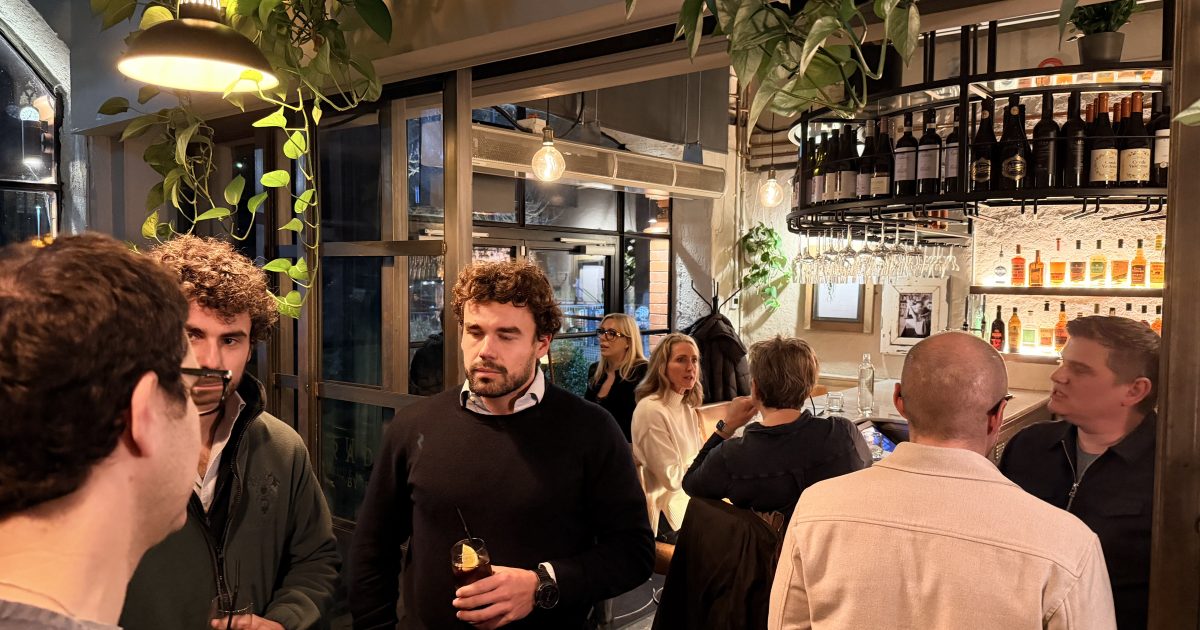 Digital Transformation Dinner: Bristol, Ten Businesses, and Why I’m Doing It Again
 -
 AIBuild Your Own Company Enrichment Engine for Under £100
 -
 B2B eCommerce PlatformsThe Composable Commerce Correction: Why Bundled Is Back
 -
 AIMaking a B2B eCommerce Parody Song with AI Tools (and What I Learned)
 -
Events & NetworkingThree practitioner stories from B2B eCommerce World that changed how I think about digital transformation
-
Events & NetworkingSavant B2B 2025